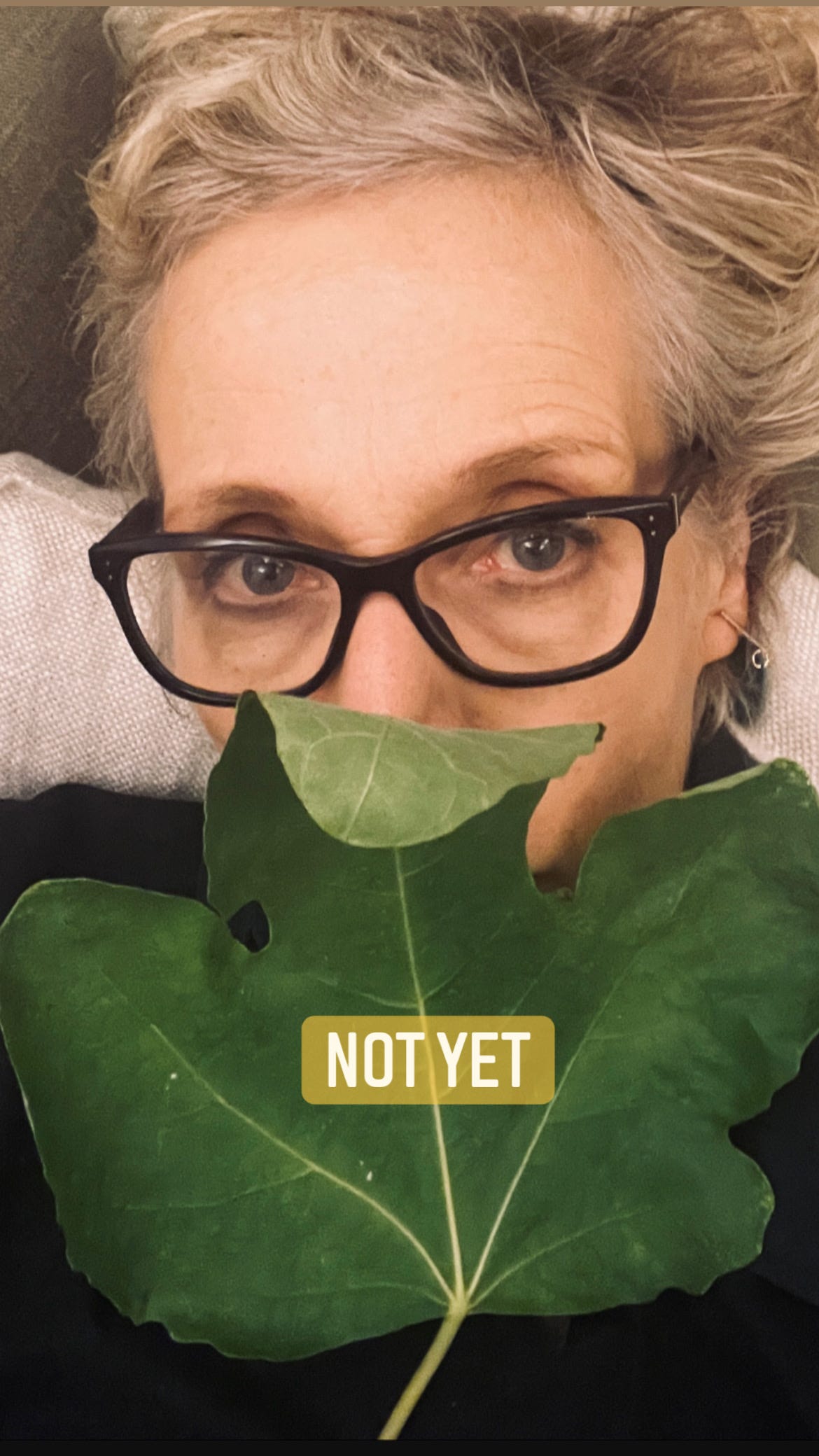
The making of a book about a break-up - an unpredictable version called Over,
'the comma in the title should reveal from the outset that any redemption or closure is out of the question'
Photo is by Ruth Rosengarten
OVER, is the story of a breakup as unexpected as it was predictable. The story is, drama aside, banal. A woman d’un certain age meets a man on an online dating app, they fall in into lust and then apparently into love too, but life gets in the way (his life) and he ditches her by email. The backdrop is the Covid 19 pandemic, that relationship laboratory (did yours survive it?).
The story is obviously mine, but it is equally obviously everyone’s, since we’ve all been subject (surely) to the vicissitudes of relationships, both the agent and object of hurt and rejection. We all feel our story as unique; we all smart in our own way. I wanted to write this out of anger, humiliation, vexation, hoping to achieve release, understanding, revenge too. But writing has its own ideas: once you are in its embrace, what matters is the text you produce, not the reality you’re referring you. And so the story, inasmuch as it is a story, began to take shape.
The first problem of writing this was how to make it interesting. She said and then he said is the terrain of gossip, and though many a writer has made a literary killing out of gossip (Proust is the prime example, but also Hilary Mantel’s Wolf Hall and several poets) I’m not that sort of writer, at least not in prose. An ordinary ditching, painful as it might be, provides no plotline. To me this was a positive point, since I usually don’t know what to make of plot: novel plots are often full of unlikely coincidences, the essential arc seeming, to me, random and forced. But still, something needs to happen if one wants to keep a reader interested enough to turn the page. I wanted something more meandering than a storyline, and also more fragmentary, to suit the narrator’s agitated mind jumping back and forth between thoughts, trying to work out what just happened.
Serendipitously, I discovered the sestude, a form invented in the context of the art world, with which, as an artist and art historian, I am familiar. Here, from the forward to the book, is a description of a sestude written as a sestude:
Sestude
The term, minted in 2011, describes a nugget of thought with the stipulation that it contain precisely 62 words. That is the inversion of 26, the number of people enlisted, each to write one such piece about an item in the exhibition 26 Treasures at the Victoria & Albert Museum. The discipline, corseting a free-form snippet of reflection, suits my flickering attention.
The number sixty-two was relevant, since I was in my early sixties, and I made that the age of my narrator:
How it started
At sixty-two, I sign up to Tinder, swiping left and right, fast nights crazed with laughing and sending friends screenshots. Tibor, 48, walks away from what looks like an airport terminal carrying a rolling suitcase, wearing swimming trunks and a T-shirt. Steve 55, 127 kilometres away, loves banter and cheekiness and says he’s 100% single, and also very honest and genuine.
To remove the text from the terrain of memoir (a minefield), my characters were all nameless, structural: The Woman, The Man, Youngest Daughter, First Husband, Second Husband, and so on. This gave me the freedom of invention and elaboration, without forcing me to be tied to the literal truth of every detail. So, rather than being tethered to fact or fiction, I employed that happy convention of poetry where “the speaker” has the freedom to be, to a lesser or greater extent, removed from the writer, a looser structure than the personality-driven narrator of a first-person novel. The speaker is a version of the self perhaps, but not bound by autobiography, not intimidated by existing temporalities or empirical facts. The speaker’s voice is subjective, it is the “I” of the text, but arguably, she cannot be meticulously mapped back onto the writer’s personal life, or at least that is the convention. It is a delicious one to employ, to hide behind or flaunt. I may have invented some facts, shifted details and chronologies, and so forth. I moved things about as I built my text out of these 62-word fragments.
Slowly, a structure began to appear. The Woman and The Man are both widowed. The Man has three daughters, the youngest of which is still deeply afflicted by the death of her mother. The Man had evaded mentioning, on the dating app, that he’d been only one month widowed when he started swiping left and right on the app. It is essential we know that The Woman is childless (not child-free), and that we have some of her romantic back story to make sense of how and why she is invested in this relationship with a man she soon discovers to be newly widowed, who lives 200 kilometres away with a needy daughter.
Photo is by Ruth Rosengarten
I realised fairly early in the process that writing about a relationship can get maudlin, and reading about it can get boring. Different kinds of writing began to slip in, and in their repetition, they play a significant part: playlists made up of evocative music tracks that The Man sends The Woman, or that she composes for him; thoughts about lists and what they provide, psychically; discussions of works of art in which themes of desire, love and parenthood too appear. French conceptual artist Sophie Calle, who made a book project out of a similar experience of being ditched (Prenez soin de vous/ Take care of yourself, 2007), plays a role (https://shorturl.at/70szX).
There are 62-word fragments of a more essayistic style slipped in, contemplating the nature of humiliation, of love triangles, of expectation, or parental duty. Most importantly, because the woman spends her days curled up (sometimes in bed in “the small room”), books and reading play a structuring role as she organises her thoughts around her reading, drawing threads together from other accounts of relationships ending or in trouble: Annie Ernaux Simple Passion (1991); Lydia Davis’ The End of the Story, (1995); Chris Kraus I Love Dick (1997); Anne Carson The Beauty of the Husband (2001); Elena Ferrante Days of Abandonment (2002); Sharon Olds Stag’s Leap (2012); Jenny Offil’s Department of Speculation (2014) and Jane Feaver’s Crazy (2021), and sometimes their intertwining.
Crazy
As in Lydia Davis’s The End of the Story, in Crazy, Jane Feaver recognises the conflation of Ardu, the man she loves, with story, and so the wreck of the relationship is tightly bound to the story of the wreck. The story was mine, she writes, but it depended entirely on his being there, and without it, without him, I was lost
From Lydia Davis especially, I took permission to consider not only the end of a relationship, but how one writes about it, as proper material for a book.
The end of the story
How does a story like this – meandering, apparently drawn from ongoing life – end? Isn’t every story’s ending an artifice, a thing elaborately staged for the purported satisfaction of narrative closure? And is it even my story to tell? I push and pull and shape meaning out of these small dents in time, sweep up and leave my fingerprint in the dry dustings.
And then, at some point, there is the meta moment when The Woman begins writing and repeats the words that begin the book:
Dream
Second Husband appears in pyjamas after a long absence from my dream life. And in the optimism of this dream, The Man hasn’t yet left me, but still I am marrying Second Husband again. It is both ordinary and astonishing to see him, and so I say bloody hell, I thought you were completely dead, and then he smiles his world-changing, downturned smile.
No spoiler alerts, so I won’t mention how the book ends, but the comma in the title should reveal from the outset that any redemption or closure is out of the question.
Cover design Book design by Armée de Verre Bookdesign, Ghent, Belgium
OVER, took a long time to compose: the writing was only the start; how to order the fragments was essential for flow and a major part of the process. During the writing, I submitted the first 5000 words (which were never arranged in precisely the same order, though the first four sestudes were in place from the outset) to various competitions. I was lucky enough to have a composition of 62 sestudes published in Ambit, the cult British quarterly literary and art magazine that ran from 1959 to 2023, and reading at a launch party for that publication was my first public airing of the work. On the basis of those first 5000, the works was long- and shortlisted for various literary awards in the genres of fiction and memoir. Sadly, I had to withdraw it from the longlist of a fairly celebrated literary prize because I had already published a memoir (Second Chance: My Life in Things, 2022): I’d not read the darned small print. In 2022 it was shortlisted for second annual Discoveries Prize, a writing development program and prize organized by The Women’s Prize Trust, in partnership with Audible, Curtis Brown Literary Agency and Curtis Brown Creative. Its remit was to seek out “unagented, unpublished women writers in the UK and Ireland, offering them a chance to break into the publishing industry with their first adult fiction novel.” Here, my publishing track record in non-fiction (mostly as an art historian and art critic, plus the memoir) did not count. The shortlisting brought many perks but did not help me to find an agent or a publisher (the work was too niche, or “we’re looking for a more dynamic plotline”) but it did bring me into contact with the fifteen other long- and short-listed writers of the Discoveries Prize. We would meet regularly, often on zoom, and from those meetings, I developed a couple of good friendships. I also learned that there was no way I could be a “standard” fiction writer, concerned with discernible narrative arcs, timelines, character developments and so on; that I was more interested in fragments that combined essayistic writing with a certain contemplative lyricism, with flashes of irony and occasional humour. And so slowly, I edged towards writing poetry, and the kind of non-teleological writing that finds its home in poetry. I am now loving my new adventures in writing poetry, exploring form and voice so differently from anything I had done in my earlier non-fiction writing. I’m currently in the final quarter of an MA in writing poetry at The Poetry School: new friends, and a huge sense of possibility and even achievement in being a newbie in a different writing discipline.
Just as I was beginning to lose momentum in my desire to get the book out into the world, I met writer and publisher Elte Rauch, whose New Menard Press is the UK imprint of Amsterdam based indie publisher HetMoet. We clicked immediately and I wrote to ask her if she’d be interested in reading my manuscript. She asked me to send it, with the caveat that she wouldn’t have time to get back to me in less than a week. The next morning, I had an email from her saying she’d read the manuscript in one sitting and loved it. There was none of the usual ambivalence in her invitation to publish the book with her, and so we started working together. I was lucky to have poet, editor and translator Astrid Alban as editor/reader, and in my final revisions, the text lost about seven thousand of its forty thousand words, improving in concision and tautness with this diet. Some sestudes got rewritten in order to make sense where others had been removed; others were subject to a new reshuffle… and now it’s at the printers and almost ready to go out into the world. There was no way the cover could have any image: anything figurative would have felt too literal. I love the simple design, with embossed title, by Armée de Verre Bookdesign in Ghent.
Though the story is personal, the magical mediating power of words and the capacity (however small!) for the speaker to peel herself away from my person means that, so far, I do not feel too vulnerable or exposed, and am simply excited for OVER, to reach readers, and curious about their responses.
The publication date is May 7th.
Buy here - (New Menard Press https://www.thenewmenardpress.com/overruthrosengarten or bookshop.org. https://shorturl.at/65ZGS)


My book! Published in two days time!