Retiring to the seaside – the cliché worked for us!
Weston-super-Mare at night
The Move
It wasn’t planned. We spent thirty years in a rented flat in Bath Spa, busy with life and work. No thought ever given to what we might do and where we might do it in retirement. But an idea was born, not of moving to exotic faraway place but simply finding a modest property for the next stage of our lives. The cliché of retiring to the seaside!
One of the joys of being older is that bus pass! With time on our hands, we decided to use it for day trips. On one such day, we had intended to spend a day in Wells, but another bus arrived first and we found ourselves on an expedition to Weston-super-Mare.
Anyone who knows Weston-super-Mare will probably be aware of its reputation. A dilapidated Victorian seaside town on the Severn Estuary with an extreme tidal rise and fall that exposes acres of muddy shoreline for much of each the day and water the colour of coffee when it does appear is called locally “Weston-super-Mud”. The tide usually comes in during the early morning and late evening, meaning day visitors often see nothing but mud for their entire visit. My husband and I had our own childhood memories of boredom and gritty sandwiches - a seaside with a grand beach and donkey rides but no sea.
At the time of our bus excursion which was 2013 - many houses in the town were private rental, converted into flats or subdivided for multiple occupation. A town in decline, a town lacking employment opportunities, a town with whole areas of dilapidated property that scored highly on the national index of social deprivation. Little wonder that property prices were generally far lower than other areas in the county and certainly lower than Bath and Bristol.
By chance on our walkabout, we came across the landlord of a small house getting it ready for sale - a modest stone terraced house in the town centre. It was in a state of neglect, but we saw spacious rooms, high ceilings and took an instant liking to the place. We decided that this must be the one. Not a recommended way to conduct any sort of property transaction, but after an impromptu tour we shook hands on a deal there and then. Within less than two months, it was signed for and conveyed and we had our new home.
The houses
Twelve years on
Still here! We didn’t have a survey, figuring that whatever needed fixing, we would just get on and fix. As the house had been standing since the 1850s, our somewhat naive reasoning was that it would probably be good for our lifetime and give us a project in retirement! We later realised that there were just as many building shortcuts in Victorian days as now, for instance, bricks laid sideways to save on materials, single skin brickwork, etc.
Fortunately, we found no insurmountable issues, and undertook most of the renovation work and graft ourselves over the following few years. A kitchen overhaul, a bathroom overhaul, new radiators, wall insulation, decorating - only calling in the trades when absolutely essential. When we had started this project, we were younger and fitter (in our mid-sixties) but not a project we would recommend or repeat now. It was hard work!
The town
Despite its reputation, the town centre and surrounding streets have always seemed a safe place. I have no qualms about walking around in daytime or evening and see far more urban foxes than wrongdoers.
The smell of weed that used to pervade the streets has almost disappeared and local outrage in the press is currently directed at graffiti, parking, bin collection, the number of empty shops on the High Street and delay in restoring the derelict Birnbeck Pier.
Transport
We sold our car early on – it was seldom used after a flurry of activity following our move. Parking is difficult and increasingly an issue. Pedestrianisation and the expansion of neighbourhood parking zones has brought tubs of greenery to block roads, and rain gardens to what were formerly free parking bays. There are novel trip hazards in the form of raised kerbs to define cycle lanes – channels that turn into mini canals when it rains. We seldom see any cyclists, though, electric scooters, seem to be in fashion.
On the positive side, there is a good, fast rail service to Bristol and Bath, abundant taxis, and a variety of bus routes to the suburbs and beyond – at least, in theory. In practice, bus services are becoming less frequent and less reliable. Life would be difficult if we were not within walking distance of the town centre and its amenities.
Dismaland by Banksy
Shopping and Entertainment
Few nationwide chains on the high street – something I missed when we first moved here. There is a limited selection of small shops and some good independent traders - all basic necessities on hand but little in the way variety and choice. Not a good place for window-shopping. Just as well that there is always online shopping and that large online trader whose drivers are constant visitors.
No shortage of places to eat – the traditional fish and chip shops once flourished but are gradually being replaced by a whole variety of new restaurants and food venues – it’s almost cosmopolitan in that respect!
Numerous social clubs - these were originally Working Men’s Clubs, Conservative Association clubs etc. All offer membership regardless of political affiliation, viewpoint or none, with politics never, ever a topic of conversation within. People tend to join them all and visit each in turn - a traditional network of warm and welcoming centres offering entertainment, excursions, food, darts and skittles and more. We have found this a friendly and welcoming place to live.
Since Covid, there has been a definite move away from evening entertainment towards daytime events. The night time economy based on the drinking of alcohol seems to be shrinking rapidly and the high street seems dead at night.
Off season is quiet – the town and the sea can look grey and uninviting in winter. Even so, there is no shortage of lunch clubs, walking groups, amateur dramatics, music, cultural events and exhibitions at the museum during the darker, colder months.
By night
A future?
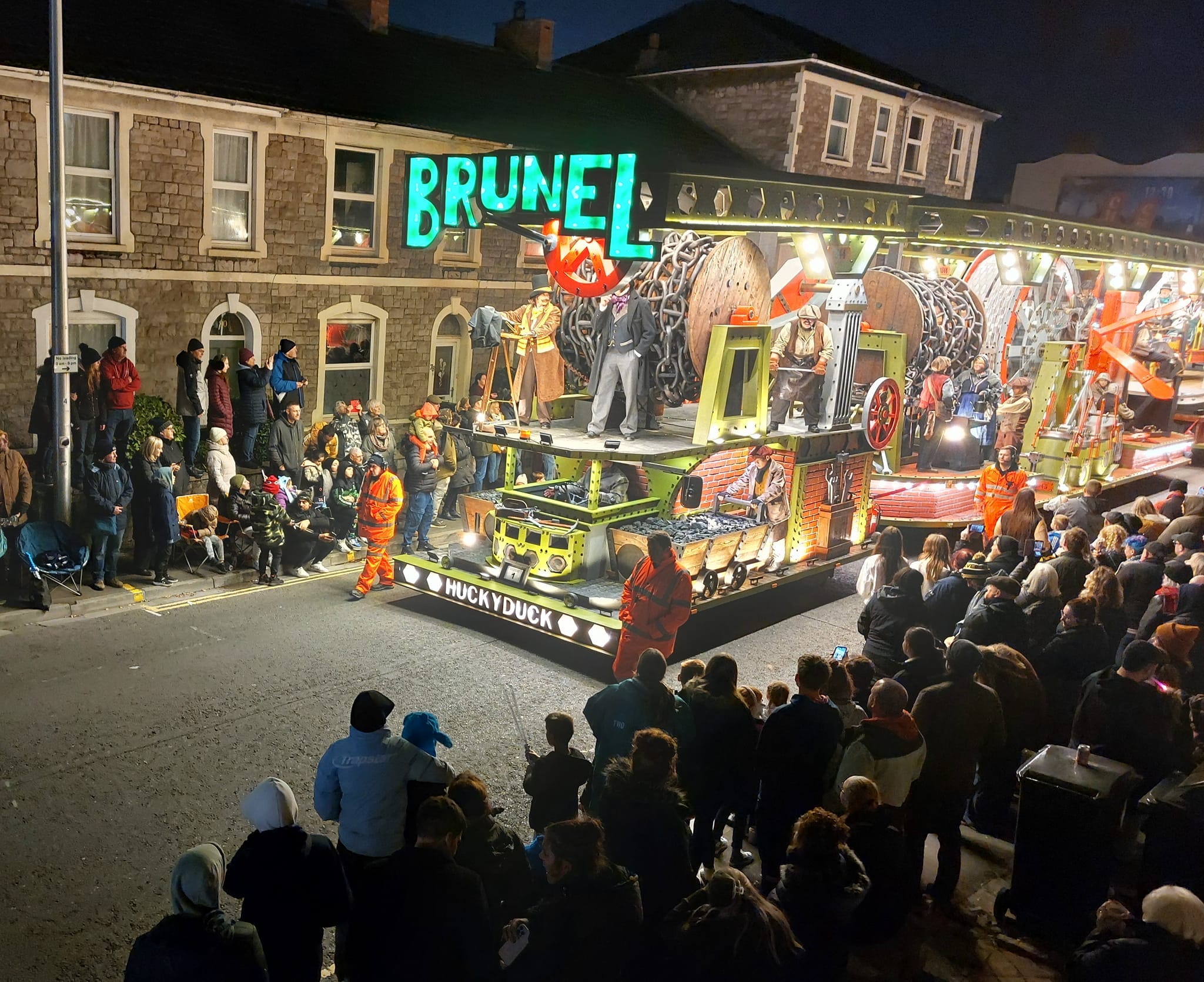
When the sun shines the town comes alive with an influx of day visitors. There is a vibrant atmosphere and a gaiety around the seafront and Grand Pier. This is the town that hosted Banksy’s Dismaland, the Sea Monster and has an annual Street Art festival, a Sea Shanty festival and spectacular Carnival (part of the Somerset Carnival circuit) - plus there are glorious sunsets!
Recently, there has been talk of the town bidding to enter a government initiative to become Town of Culture 2028, so maybe our town will see a renaissance. Who knows - we live in hope.


