Lake Norman – Where is everybody?
“That’s the name of a Twilight Zone episode,” Gerry remarked. “Look it up.”
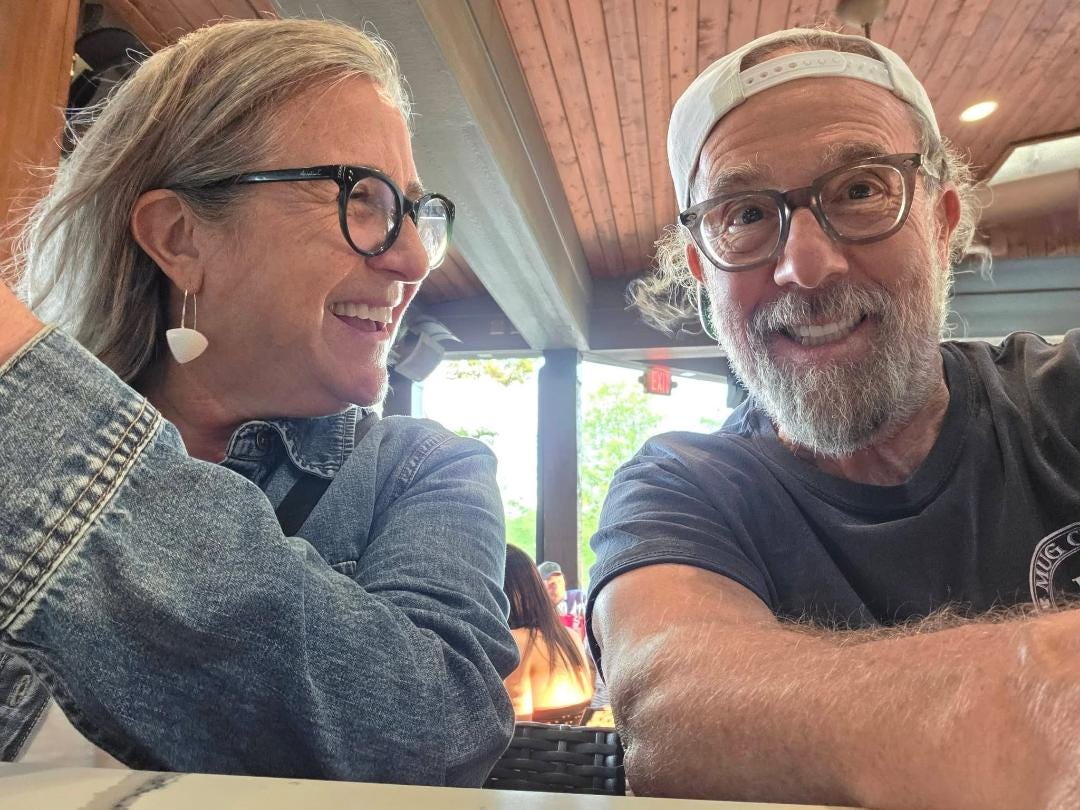
Leslie and brother, Gerry, at Lake Norman
A day and a half in my life—centuries beneath it.
For the best part of Saturday and Sunday, I kept a lot of my thoughts and feelings to myself. But I only had 24 hours at Lake Norman, so after an off-kilter lunch and an almost too-perfect lakeside dinner at two of its many restaurants, half my time was up, and I had to ask:
Where is everybody? That’s how the conversation started in earnest.
Before that, our time together was filled with fun and exuberant exclamations, inspired by being in a new place, fine weather, good company, and a valued reunion.
My brother Gerry and I always have a great time together. He was heading down from upstate New York to Lake Norman. He’d lost his little house in Indian Rocks Beach, Florida, to Hurricane Helene and was curious about what Lake Norman might offer. I’ve been in Brevard nearly three years now, and haven’t seen much of North Carolina beyond it—more of South Carolina, actually: Greenville, Charleston, Folly Beach—so I was keen to meet him there, but I wasn’t entirely sure I’d make it.
At the end of the month, I will be turning 67. Four weeks ago, I started a six-week challenge to lose some stubborn weight and body fat by my birthday. Some guy online promised results if we stuck to it. I’ve tried before—but this one seemed different. I was 99% cynical and 1% hopeful—but I committed. Beyond that 5% body fat, what else did I have to lose?
The workout required focus, and in week two, pushing through the last sets, one small lapse triggered an injury that stopped me short. My back has always been my weak spot; I usually need a tune-up once a year. This time, it needed more. Two sessions with my wonderful therapist weren’t enough. Up until the day before I was due to travel, I was still in pain and unsure I’d be able to drive. But I packed, willed myself toward better, woke early, and got on the road—about two and a half hours due east. I love my brother. I don’t see him often. And if Lake Norman didn’t work for him, he said he might look closer to Brevard. I had a stake in this.
Nothing is alluring about the name, Lake Norman. It lands like a thud, nothing romantic, maybe the personification of a body of water is what draws people in droves. We all know someone named Norman.
Who doesn’t love a Norman? Urban Dictionary defines Norman as ‘a regular dude trying to survive in this terrible world.’ Photos online were impressive, and there was clearly a buzz about the place, so I understood my brother’s attraction to it. My only reservation was that it wasn’t really a swimming lake, and Gerry and I both love to swim. We swim together whenever we can, and the fact that he was looking for a place on or near lakes down here in North Carolina was an exciting prospect. Let’s go see Norman.
I kept a lot to myself that day. As I neared the area and hit traffic on the highway, I already missed the peace and quiet I’d left behind in Western North Carolina. Within minutes of arriving, something felt off. All very new. A corporate feeling to the place. Lovely, clean, manicured, but vacuous. Man-made —that was the word that kept returning. New builds everywhere. Space for more. But where was the old? What had been here before?
Heading down to the water from traffic-laden West Catawba Avenue, the road winds past an apartment complex and parking areas to reach Hello Sailor, where we met for lunch. Very busy, verging on the chaotic. We felt invisible until my unmissable hand gestures and a few deliberate hellos caught a server’s attention. We remained in good humour, but the experience warranted some criticism — even the name, Hello Sailor, with its mid-century modern beach club vibe, felt a bit forced.
By evening, after dinner at Eddie’s, another lakeside restaurant with hour-and-a-half waits for outdoor seating, we went looking for ice cream. The creamery sat in one of those live-work-play communities—clean, walkable, thoughtfully designed. Everything in its place. Sterile. Faux, even.
Where is everybody? I wondered. Everybody was lakeside.
Lake Norman, North Carolina’s largest man-made freshwater lake, covers 32,000 acres and has more than 500 miles of shoreline. It stretches across the towns of Cornelius, Davidson, Huntersville, Mooresville, Denver, Sherrills Ford, and Troutman. They call it an inland sea. It is, undeniably, beautiful. And people have built their lives along its edges.
Ice cream at Two Scoops was good, but we were the only two in there.
I said it out loud this time, “Where is everybody?”
“That’s the name of a Twilight Zone episode,” Gerry remarked. “Look it up.”
I did. It was the very first Twilight Zone, from 1959. How about that? We enjoyed the remarkable trivia as we worked through way too much ice cream, happy to see a few others trickle in and out.
That night I had a very bad dream. Gerry had to wake and check on me—I was screaming. Most of the details did not bear repeating, but the feeling hung heavy: disturbance, violence. When he asked, I told him cryptically: “I was being bludgeoned by a dull instrument”.
After we found breakfast—without the long wait—we went to Lake Norman State Park. A massive lake where swimming was prohibited, even wading. Plenty of people, but it was too quiet. The place felt controlled and eerie. I found myself unsettled by the contradiction: water everywhere, but no one in it. A lake you couldn’t enter began to feel like a mirage. And just beyond—vast, expensive, lakeside homes—not beautiful to my eyes—and oddly hollow. Not a person in sight. The passing speedboat could have been driverless. The cynic in me imagined a life inside one of these starter castles: a woman in a pristine kitchen, nibbling carrot sticks. Nails and hair, perfect. Never cooking. On her phone, making reservations. Everything maintained. Nothing lived.
I’d had enough. I was ready to leave. But this question persisted—where was the old town?
“Let’s look it up before I go,” I said. And when we did, we found our answer. It was under the lake.
Before it was a lake, this land was home to generations of the Catawba people. Beneath the water now lie 19th-century mill villages, flooded farmland, forests, cemeteries, old bridges, abandoned roads, a summer camp, even a plane wreck—a whole landscape submerged. I felt it before I knew it. In that instant, the unease I’d been feeling made sense. The disconnect clicked right into place. Lake Norman was built on what had been erased.
And it isn’t the only one. Across the ocean, there is Tryweryn—a Welsh village drowned to create a reservoir for Liverpool in England. A community, its school, its cemetery, forced beneath the surface.
My family’s history is underwater, too. My great-grandfather’s farm was sold to New York State. It was flooded to create the Neversink Dam.
Three words:
Never. Sink. Dam.
A name that reads like a promise.
Or maybe a prophecy.
Houses may sink; history does not.


