ENOUGH
When did we forget how to stop?
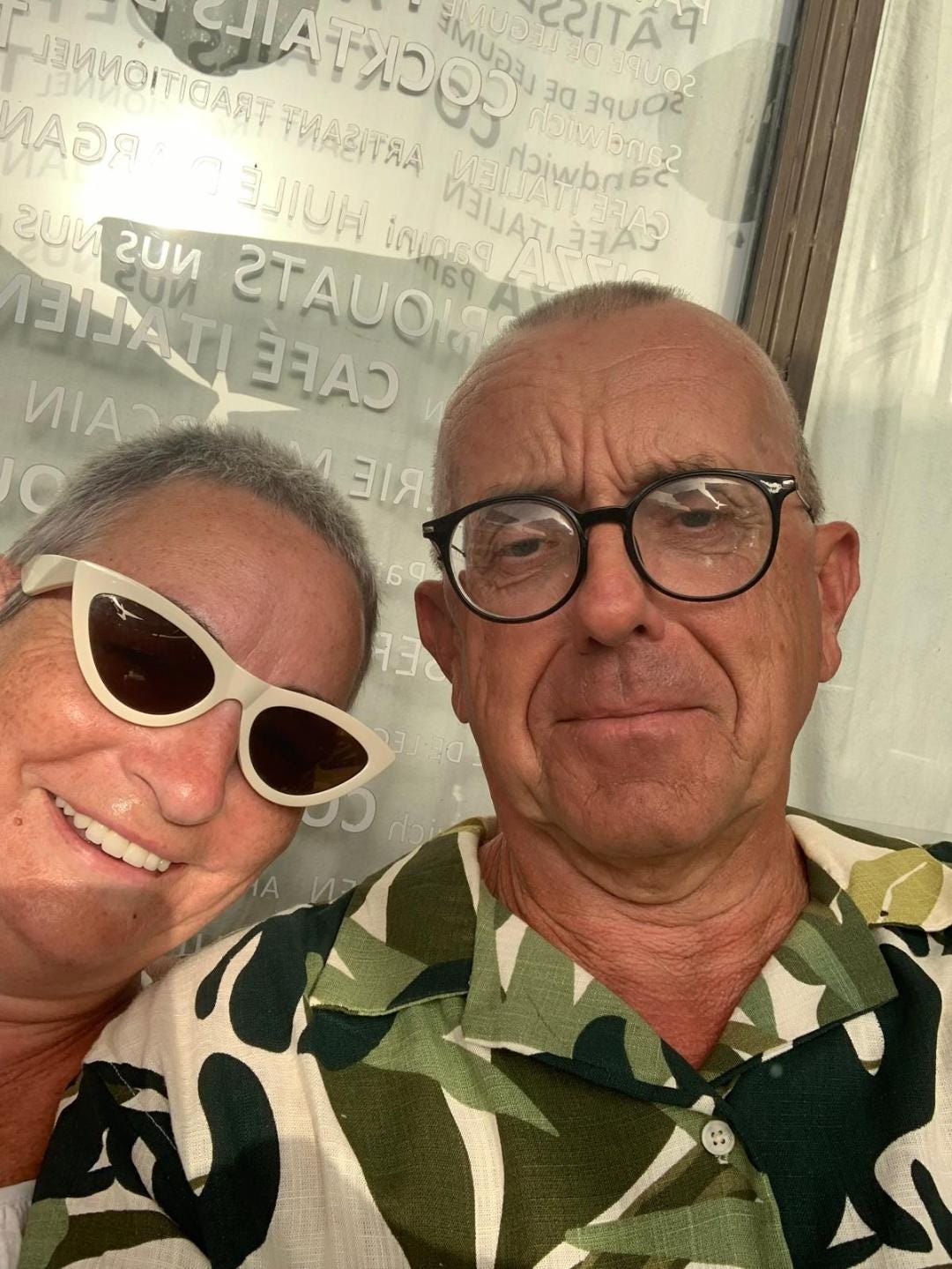
Jane and Patrick
I want to tell you about two moments that changed the way I think about everything.
The first was in a town square in Turkey, maybe fifteen years ago. Jane and I were on holiday - one of those holidays where you spend the first three days just decelerating, remembering how to sit still.
On one of those early afternoons I noticed a gathering in the square. Men of various ages, cards and chess, afternoon sun, no apparent urgency, no visible guilt about not being somewhere more productive.
I got talking to one of them. Asked what the story was.
He looked at me with the mildly puzzled expression of a man being asked to explain something completely obvious.
We have done enough today.
Five words. I’ve been thinking about them ever since.
The second moment came considerably closer to home. Jane and I had spent the best part of our careers as trainers (in the beauty and barber industries) in the UK. We were good at it - good enough that we spent three or four days a week on the road, criss-crossing the country, full diaries, good money, successful by every conventional measure.
I was approaching 60 when it dawned on us - and I use us deliberately, because this was never just my revelation - that the life we were living wasn’t the life we actually wanted.
We were stuck on the hamster wheel of modern life.
We realised we didn’t need more, we actually had more than enough.
What we needed was to focus, or, actually, to refocus.
What did we want less off? Endless motorways, anonymous Travelodges, waving at each other as our paths crossed on the M62.
What did we want? Certainly not retirement! But more time together, a gentler pace of life, to continue training
So we made a decision.
Not a dramatic one - we didn’t quit, didn’t burn anything down, didn’t move to a yurt.
We redesigned.
Moved to Spain. Bought a house big enough that students could come to us.
Casa del Torres is in Almeria, a province of Andalucia
Still working, still earning, still doing what we love - but on our terms, in a place we actually want to be, at a pace that doesn’t require us to be permanently running on adrenalin.
Writing that down, I realise that Jane and I are living proof of a concept I’m now writing a book about. We are now 63 and 66 respectively.
I’m calling it - Enough.
Here’s the thing about the word enough. It does something interesting when you put it in two different sentences.
I’ve had enough.
I have enough.
Same three words. Completely different meaning.
One is defeat - exhaustion, resentment, the end of a rope.
The other is a victory - clarity, intention, a conscious decision about what a good life actually looks like for you specifically.
This is Enough
Most of us spend our lives somewhere between the two, running hard towards a destination we’ve never properly defined, for reasons we’ve never properly examined, because that’s what everyone else is doing and stopping feels like falling behind.
The men in the Turkish square had found their enough.
So, eventually, had we.
And what strikes me - having thought about this for a long time and talked about it with a lot of people - is that finding it is both simpler and harder than it sounds.
Simpler, because enough isn’t a radical concept.
It isn’t a lifestyle overhaul or a grand gesture or a manifesto for selling everything and moving somewhere with better sunsets.
Jane, Patrick and grandson
It’s just a decision - or rather, a series of small decisions - about what actually matters to you and what doesn’t.
Harder, because we live in a system specifically designed to make that decision as difficult as possible
We didn’t end up on the hamster wheel by accident.
The wheel was built for us, around us, refined over decades by an advertising industry that understood - long before we did - that a slightly dissatisfied consumer is a profitable one.
Not miserable. Not desperate. Just always wanting the next thing.
The upgrade. The new model.
The version of success that’s perpetually just out of reach.
And then the internet arrived. And then the smartphone. And then social media - the highlight reel of every life but your own, delivered directly to your pocket, twenty-four hours a day.
The result, for most people I know, is a low-level, persistent anxiety.
The sense of being permanently slightly behind.
Of running hard without a finishing line, no off ramp.
Sound familiar?
Here’s what I find important - and what the self-help industry consistently, conveniently fails to mention.
This isn’t a personal failing.
It isn’t a discipline problem or a mindset problem or something that can be fixed with a better morning routine.
It’s a structural one.
The wheel was designed to keep you running.
Recognising that is the first step to doing something about it.
So what is enough, exactly?
It’s identifying the point at which your needs and wants are satisfied.
This isn’t settling for second best.
This isn’t the absence of ambition.
It’s the redirection of ambition - pointing it somewhere specific, towards the life you want to live rather than just your career, towards the things that will actually matter when you look back rather than the things that look impressive from the outside.
It’s also deeply personal.
Your enough looks completely different from mine, from your neighbour’s, from anyone else’s.
Which is precisely why nobody else can find it for you - not a book, not a guru, not a programme.
What I can offer is a way of thinking about it.
Start with one honest answer.
What would you do with an extra two hours a day?
Not what you think you should do.
What you’d actually do, if the time were genuinely, unstructuredly yours.
Because the answer to that question is a fairly reliable map of what you actually value - and how far your current life is from being built around it
The other thing worth saying about enough - and this is the part that tends to surprise people - is that you don’t have to blow up your life to find it.
I hear the objection already. Easy for you to say. I’ve got a mortgage, kids, responsibilities. I can’t just opt out.
And you’re right. Most of us can’t, and shouldn’t, and don’t need to.
Enough isn’t about opting out. The mortgage is real. The kids are real.
The responsibilities are real.
Enough works with them, not against them.
What it starts with is something much smaller.
A boundary. One specific, achievable, entirely undramatic boundary that doesn’t require you to blow anything up to put in place.
I want to be able to pick the kids (or grandkids!) up from school on Fridays.
I want to stop answering emails after seven o’clock.
I want to watch my son play football on Saturday mornings without checking my phone.
These aren’t small ambitions dressed up. They’re the things that actually matter - and the fact that they feel like luxuries to busy people is precisely the problem that enough is trying to solve.
Start with one. See what happens.
My consistent, reliable, rarely-wrong suspicion is that what happens is not very much - and that not very much will feel like more than you expected.
Small enoughs don’t cause ripples.
But small enoughs lead to bigger ones.
The men in the Turkish square weren’t living a life of grand gestures or radical simplicity.
They are just people who have a clear idea of what they needed, and who allowed themselves to stop when they got there.
No guilt. No negotiation. No anxiety about what they were missing.
We have done enough today.
That’s not a lifestyle brand or a wellness concept or a philosophy that requires a particular type of water bottle.
It’s just what a life looks like when you decide - consciously, specifically, on your own terms - what enough actually means for you.
I’m writing a book about it.
But the book is short, deliberately and defiantly short, because a book about enough should practise what it preaches.
Everything it needs to say, said without padding, without a twelve-step programme, without a 5am morning routine.
Just a conversation between friends - one of whom is a little further down the path, and would quite like you to enjoy the journey.
The question isn’t whether you deserve enough.
You do.
The question is - what does yours look like?


