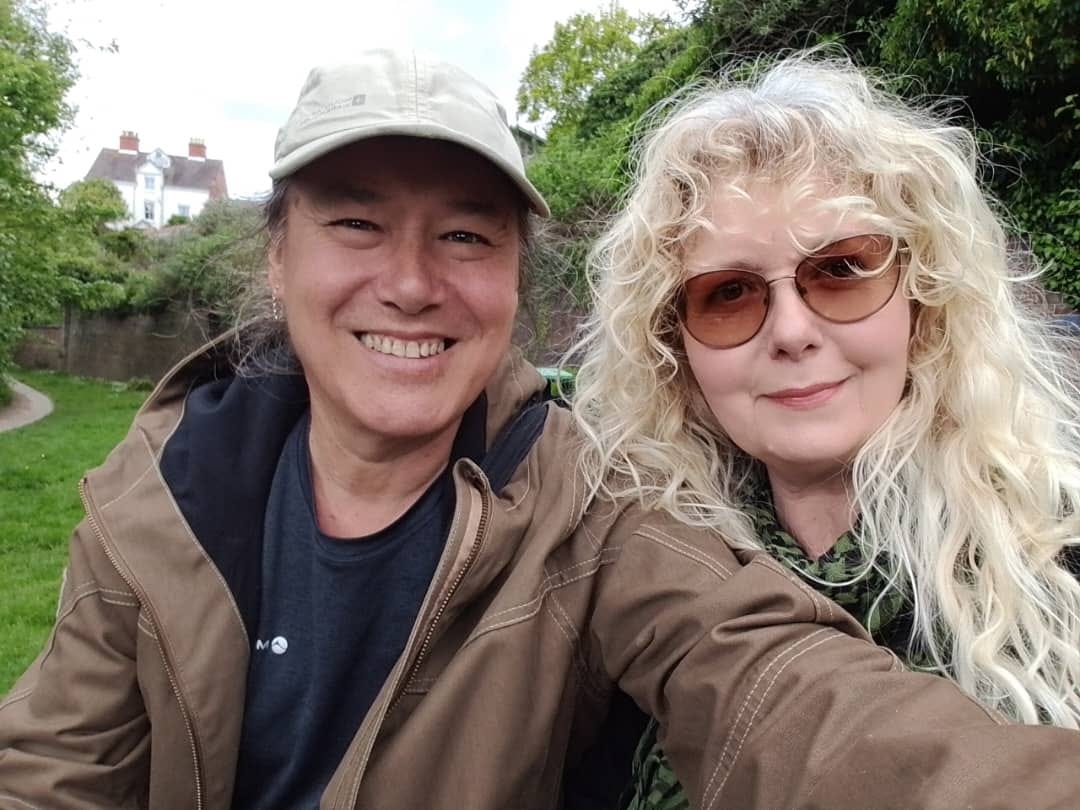
Defying my belief that people die at 70!
'That my mother’s family knew who this special woman was extremely important to me.'
Mike and his beloved Karen.
I grew up with a profound belief that people die at 70. “Three score years and ten” was the script for life that my dad gave me and I dragged this invisible anchor along devotedly until, at the age of 26, studying psychotherapy meant I had the permission needed to challenge such assumptions. I began to believe that I was actually questioning those preordained values and expectations. It doesn’t feel good to knowingly pursue archaically incorrect programs. Yet the confrontation of such apparent truths is hugely threatening to one’s sense of self and safety.
Perhaps due to similarly programmed misunderstandings, I grew up, drifting from longish, hopeful, engaged relationships, inevitably bound in ultimate and subtle self-sabotage. As time has matured me - and it has - the foundation of challenge, laid 40 years ago, finally flowered and I began to believe I could, and would live beyond my father’s life-limiting sentence. I also allowed myself to finally find someone I dared to hope I would spend the rest of my life with.
Book Tickets by clicking here.
Such optimism was tempered with the galling realisation that - in the grand scheme of things - time had been wasted and I would have to optimise on what little time I had remaining.
I began to make little risk-based steps based on a faith in living beyond 70 years. With my new free heart plus my risk-taking relationship, I introduced my sweetheart to my long deceased mother’s Malaysian family in a 17 day whistlestop tour of the Malaysian peninsula, particularly focused on my beloved uncle Terry, who had surpassed that 70 mark himself, by a decade and a half.
That my mother’s family knew who this special woman was extremely important to me. Equally, I was anxious to introduce my life’s later social circle to her too. Thus, this year, I booked us into a month of Aotearoa - New Zealand - where several significant people to me, still resided. The Maori of Aotearoa have a term for a circle of close human beings, extending beyond family, to anyone who has close significant meaning.
Some of Mike’s wonderful people in New Zealand.
That term is whanau - pronounced fah- noh - I wanted my whanau to know this woman and she them. The trip was delightful, despite an untypically typical monsoon period. I showed her so many dear, dear places and my wonderful people of there and relived some wonderful travel experiences, but also made some new ones, with her. It filled my heart that they had so readily welcomed Karen into their hearts alongside me. And then, all too soon it was time to return. We were both saddened and yet ready to head back to the place we had made home together though. So it was, as my yoga teacher used to call such scenarios - a sweet ache.
We were not looking forward to the two full days of return flights so we treated ourselves to some Malaysian street food and with an hour left, I made my way to the smoking deck alone, for a fix of vaped nicotine. Nicotine addiction is poorly catered for on international flights these days so I took some extra long and deep draws on my machine, getting an actual ‘Blue Ice ‘hit’. But then, that understood experience changed. Dramatically.
I was almost immediately confused. My consciousness started to weave in and out of the airport twilight and it was all I could do to acknowledge that something was definitely wrong. My hearing became distant and exacerbated my tinnitus and my head suddenly began to throb painfully. Suddenly, it occurred to me that something was seriously wrong but I had no idea what. All I chose to focus on was getting back to Karen.
Whatever I did, that was my one priority. Karen, Karen, Karen was pretty much all I could think. I staggered down through the duty-free shop, past Papa Rich where we had earlier dined on dumplings and curry, and somehow got onto the double escalator. I knew I had left Karen in the lounge at the top of this. My anxious panic and urgency had increased tangibly with every step, each one bringing with it a doubtful query about whether I would make it back to Karen.
My sense of relief was huge seeing Karen on the large, incredibly uncomfortable, brown plastic sofa. She knew something was very wrong as soon as she saw me and I slumped onto the sofa next to her. “Something’s wrong, I feel really unwell”.
There followed a short period of internal and external debate. We were being called to our gate and it would be a real hassle to miss the flight. But all I could think was that there was no way that I could fly like this. As the shooting pressure and pain continued to hit me, I confessed that I thought I needed urgent medical attention. The next few hours were a blur of questions from inexperienced but well-meaning, on-site medical personnel and a tortuous, painful wait for transport onto more specialist diagnostic staff.Before I lost consciousness, I remember begging, begging and pleading pitifully, for pain relief. I have never experienced such an unbearable headache, this characteristic ‘thunderclap’ headache I now know associates itself with a brain aneurism. I remember now that Karen had been able to rely on my dear friends who apparently ended up driving me to the hospital to save time waiting for an ambulance. And then I woke up, several hours later, incapable of remembering what had happened, still with a merciless headache and eyes incapable of focussing or seeing single images.
It seems I had developed a congenital (from birth) condition known as an arteriovenous malformation in my cerebellum. This had generated an aneurism which had then haemorrhaged and also given me a minor stroke.
In hospital in New Zealand.
Bizarrely, my late, older brother Joe, also developed the same thing in his 30s, yet there is little medical evidence of this being a familial phenomenon. We were just both damned unlucky. Or, lucky, depending on how you perceive things.
The medical details are somehow unimportant. The effect is not. The incapacitating, the invalidating and disregarding is profoundly disrespectful. It doesn’t care about you, what you have done with your life, who you have been as a person. Whether you’re good or bad. I suppose that it does make judgements on whether you have respected yourself or not, to an extent. But damn it, I discovered that I had just been statistically unlucky.And for that, it took away my driving license, effectively imprisoning me in my rural home. I eventually made it home to North Wales. It told me not to exert myself for fear of generating a further aneurism. My love of rock climbing, itself having dwindled into a more leisurely pastime (due to various elements like location, chronic tendonitis, a decade of inactivity and getting fat), is by definition a form of exertion. As is lugging even a light camping backpack (my other passion) around. Or walking up a steeper mountain. The awareness of the risk of death is, I became aware, a crippling, disabling awareness, where previously the choice of taking that risk was a paradoxical luxury. At a time when I had just allowed myself the luxury of living longer than I had supposed, with no recourse to having lived an unhealthy life style, something else had intruded and impressed itself onto my mortality, onto my contentment and happiness.
I could have delved deeply into a sense of despair and hopelessness, of life being unfair. Or of fateful acceptance that this is what you get for denying your indoctrinated God’s existence (I’m working on that one...). But as unpleasant, inconvenient and damned unfortunate this whole affair has been, it has opened my eyes to what joys I have in my life.
The people that I love. The things I am capable of, that would have otherwise been neglected. My dear Uncle Terry who died just over a month ago, was the epitome of positive thinking. His daily messages, which at times, I confess, had seemed trite and platitudinous, really had a point. We are not out of the woods yet. The next step of surgery may get rid of the further risk of more aneurisms. But it carries some risk, of course. And for that, I insist on relishing what I have now. It’s not that I’m not pissed off about it, but that really shouldn’t get in the way of valuing so much loveliness in my life. Life really is too short to not see the good things. I am 62 now and still looking beyond 70…
The birds of love.


