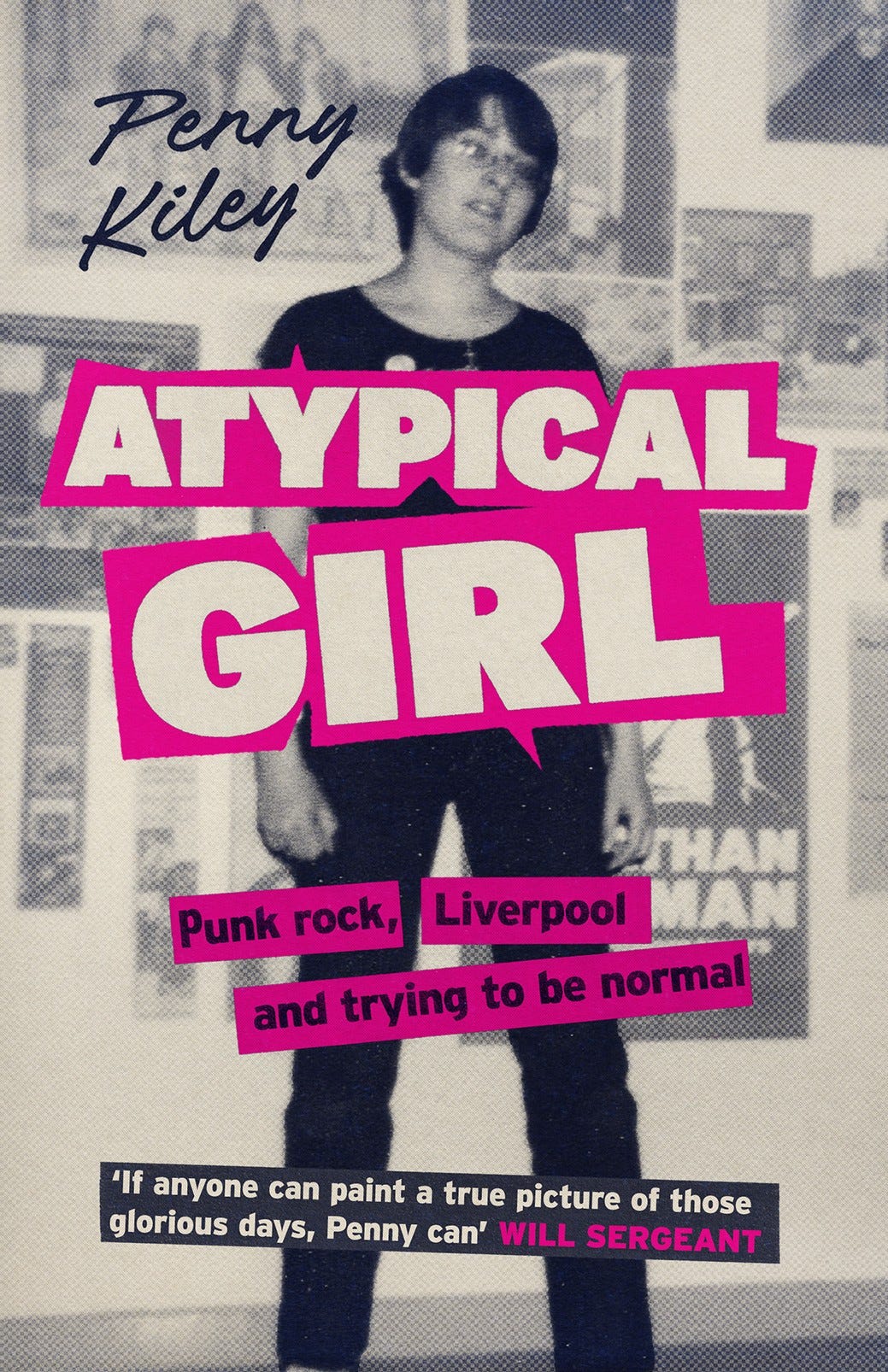
Atypical Girl: Punk rock, Liverpool and trying to be normal
New Book and book tour
We’re at that age when we are supposed to be talking about bucket lists. But I’ve only ever had one item on mine, and it’s been there since I was five years old. Ever since I learnt how to read, I’ve wanted to write a book.
I’m 68 now and my debut – a memoir titled Atypical Girl: Punk rock, Liverpool and trying to be normal – is published by Polygon on 5th March.
It’s a milestone in a series of milestones that happened later in life. And I don’t think I could have done any of those things when I was younger.
I was 41 when I graduated with an MA in creative writing. I hadn’t enjoyed my undergraduate degree very much: I was burnt out from “twenty years of schooling” (as Bob Dylan put it), and didn’t fit in at university. When I started my MA, it was something I’d chosen to do, and I worked hard at it and had fun and found my voice as a writer.
I was 50 when I started my first blog. It was called Older Than Elvis (strapline: “Elvis didn’t live to be 43. I did.”) and it let me explore the weird transitional experience of going through middle age. I also wrote about music, feminism and autism, all themes that would become part of my book.
I was 60 when I found out officially that I’m autistic. Obviously, it wouldn’t have happened when I was growing up because there was very little awareness generally, and even less about autism in girls. I had to work it out for myself.
And I was 66 when I got my book deal. I’d been writing the book for a long time and it evolved over the years. I always knew that part of it would be my testimony about life in a male-dominated industry, working as a freelance music journalist. I realised later that another theme would be reinvention, something that I’d become accustomed to after years of autistic masking.
Once I’d written it, I had to find a publisher. It wasn’t easy but I’m very happy with where I’ve found myself. Polygon, now part of Scottish indie publisher Birlinn, has (according to the history on their website) “a rebellious past”. And, of course, going with an independent is more punk rock.
Punk rock
They say that this year, 2026, is the 50th anniversary of punk. I’m not sure how I feel about that.
Firstly, “ground zero” might have felt like 1976 if you were in London, or part of the Sex Pistols clique. It didn’t really feel like that in the rest of the country. (As for the rest of the world, well, the Ramones had been going since the early ‘70s.) Most people I know who were part of the original wave of UK punk would say that 1977 was the really big year.
It was for me. In February 1977 I walked into Eric’s for the first time. The small club in a Liverpool backstreet had opened a few months earlier and had already put on the Sex Pistols (a non-event by all accounts) and the Stranglers. I’d heard about it through future pop star Pete Wylie, who I met at university. It felt like home.
During the next few years, we saw all the punk bands that mattered: the Damned, Siouxsie and the Banshees, the Heartbreakers, the Fall, Penetration, the Slits, the Raincoats, the Adverts… And, of course the Clash, everyone’s favourite. (I never did see the Sex Pistols, but it didn’t matter.) Before long we were getting our own bands too. Big in Japan and the Spitfire Boys started it: many, many more continued the story.
But the bands were just a small part of this new movement. What it was really about was what we called “attitude”.
That attitude was about reinventing rock music at the grass roots – by young people, for young people – and reclaiming it from the music business. But it was also about reinventing ourselves. That wasn’t just about clothes. It was about permission and possibilities, rejecting the conventional paths we were expected to take and becoming someone different. In my case, a freelance music journalist: I started writing for Melody Maker during my final year at university.
Punk was about change and creativity, rejecting the past and making something new. That’s the other reason why I want to question the “50 years” concept. Because punk wasn’t about looking backwards or wearing a uniform or doing the same thing for five decades
.
Liverpool
When punk happened, young people of my generation felt represented, and listened to, and part of something, and empowered. Eric’s was a big part of that, too. Everyone who was a regular at the club will tell you it was special. It was more than a venue: it was a club. And it was more than a club: it was a community. It felt like a sanctuary for misfits. It was somewhere to be with like-minded people, learn new things, be inspired and grow creatively.
Eric’s became known as a punk club, because that’s what was happening at the time, but it was always more than that. The people who ran it cared about music and they’d put on anything they thought was good, so we got an eclectic music education. I always believed that was the reason that the bands that came out of the club were so interesting and different: Echo and the Bunnymen, The Teardrop Explodes, Orchestral Manoeuvres in the Dark, Wah! Heat, Dead or Alive, just for starters. You might say they were post-punk before anyone else.
After Eric’s closed, the music continued. I worked as a music and arts journalist in the city throughout the 1980s and 90s and that story is also part of my book. I wanted to present a different side of Liverpool that people outside don’t know about: that it is a creative and artistic place. After all, it was European Capital of Culture in 2008.
Trying to be normal
There are some similarities between being a punk and being autistic. People say “a bit punk rock” when they don’t really get it, and “on the spectrum” when they don’t understand that either. And, of course, both are about being outsiders.
Maybe punk didn’t last long, but the effects did. One of the most enduring aspects of the punk attitude is what’s become known as “the DIY ethos”: doing things for yourself, because no-one else will. I’ve spent most of my career as a freelance, because autistic people and traditional workplaces don’t get on. My life has never been completely conventional even when I have tried to be. And now that I’m old, I’ve stopped trying.
In my memoir, the story comes full circle, and I feel my life has too. The way I was at 18 makes sense of the way I am at 68. And knowing now that I’m autistic makes sense of who I was at 18.
I have accepted myself as I am and accepted a life that is different from many of my peers. I know now that that’s OK. For me, that’s the real legacy of punk.
You can buy Atypical Girl here - https://birlinn.co.uk/polygon/
Penny is about to do a book tour - do go along.


I really enjoy @pennykiley ‘s Substack and am looking forward to reading her memoir. Great to see her words featured here.
Punk, autism and a life - what's not to like, sounds like my life. Of course I rushed to order but of course the publisher won't deliver to France. And why not? It's not as if we're a war torn nowhere ... oh well.