AofA's Hot To Trot Talking Points
Every Friday
Be surprised at our mixture of debating topics. We love to be eclectic.
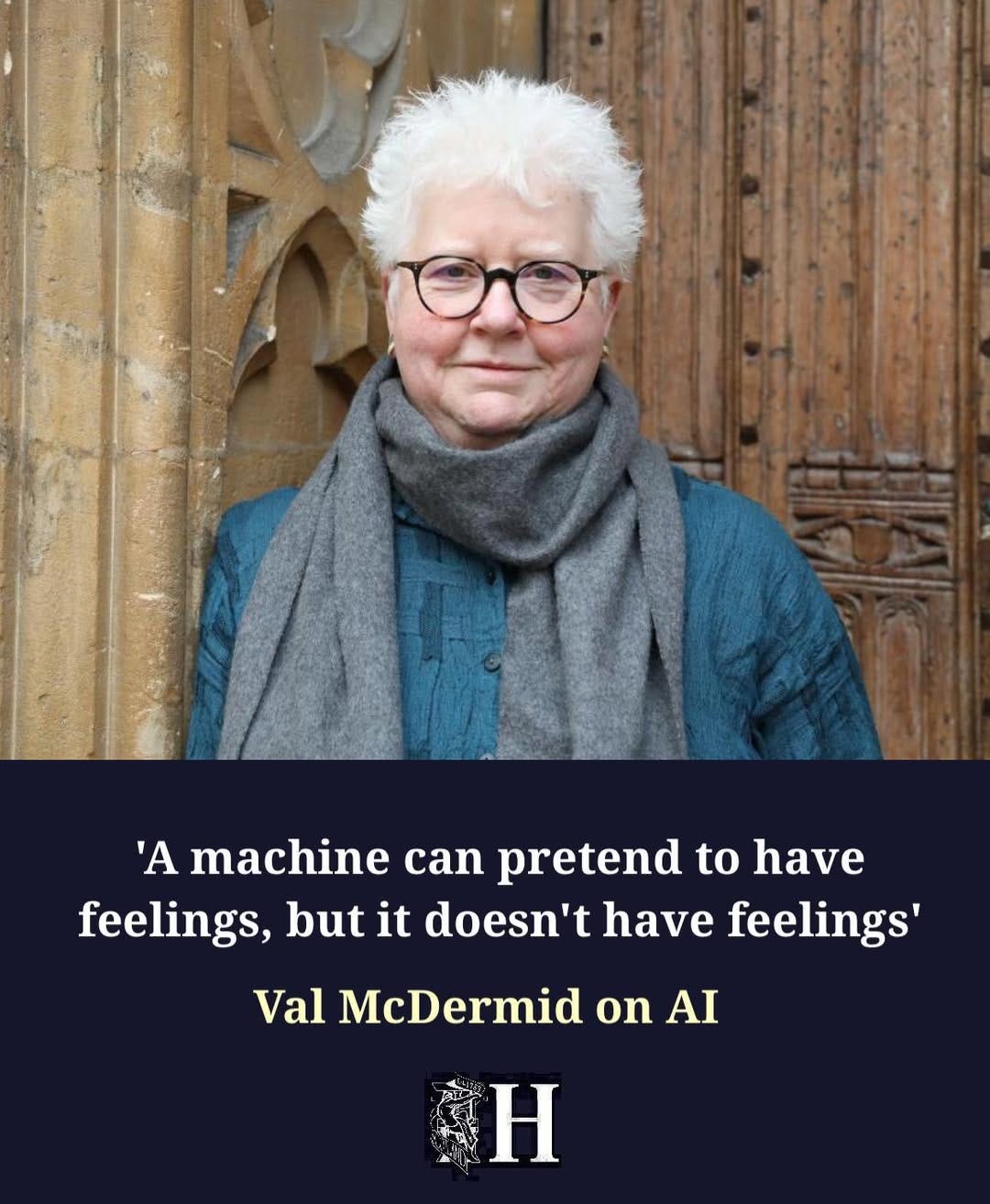
We’re all worried about what’s happening to writers and artists. Their worked being scraped by AI companies - no permission, no royalties. Val McDermid talked
about her experiences in the Herald. ‘Val McDermid turns 71 today.
In February, the Scottish crime writer warned that writers are facing a ‘massive threat’ from artificial intelligence.
She said: “AI can produce a certain kind of book and it is learning all the time. The only reason it can produce any books at all is because it’s stolen out of all of our texts. All of our texts have been scraped.
“They have taken 150 pieces of my work, for which I’ve had no recompense, they’ve not asked my permission and I have no say in what they do.
“There are court cases on the way now, but it’s tip of the iceberg stuff.
“There was never any point when they sought a partnership with creatives. They just stole our work and ripped us off.”
The author said she was confident that writers would always have a way of writing in a way “that cannot be replicated by a machine.”
She added: “A machine can pretend to have feelings, but it doesn’t have feelings and it doesn’t understand emotions at the deep level that we do that.
“Sometimes when you are reading a book and an event happens you expect the characters to behave in a particular way, but they don’t.
“They respond in a different way because they are human because they have a range of possibilities.
“I think the human writer will always have a head-start on the machines for that.”’
2. All round amazingly creative woman - artist, stylist, body armour maker - Izzy Bicknell died suddenly earlier this year. Her best friend, Vivienne Austin wrote an obituary for the Guardian that captured Izzy’s spirit.
‘My friend Isabelle Bricknall, who has died aged 71, led a richly creative life spanning fashion, art and music. Over several decades she worked as a model, fashion designer, stylist and artist. She brought an instinctive eye for colour and composition to everything she did.
From the mid-1970s to 80s she worked with the British designer Zandra Rhodes, carrying out hand-finishing, beading and embellishment work on garments while also modelling in the fashion shows. Working for Rhodes fostered Izzy’s lifelong appreciation for bold, theatrical design.
Her longstanding connection with the illustrator Jo Brocklehurst led to Izzy co-curating Nobodies and Somebodies at the House of Illustration in 2017, which celebrated Brocklehurst’s portraits of the punk and club scenes of London, Berlin and New York. One of the drawings, Ruber Angel (1994), was of Izzy wearing the distinctive steel “body armour” she designed and made with her boyfriend at the time, Anthony Gregory, that was popular on the fetish club scene.
A portrait of Isabelle Bricknall by Brian Would
Born in Surrey, Izzy was the daughter of Odette Vincent, a hairdresser and beauty therapist, and William Bricknall, an engineer then business administrator in the oil industry. They moved around for William’s work, including a period spent in Montreal, Canada, eventually settling in Suffolk, where Izzy attended Claydon secondary school. Izzy studied dress design and manufacture at Great Yarmouth College of Art and Design, then completed an MA in fashion and textiles at Trent Polytechnic (now Nottingham Trent University) in 1975.
After collaborating with Rhodes, Izzy became a familiar figure within London’s creative circles, working across modelling, styling and performance. She modelled often for the fashion illustrator and lecturer Colin Barnes, as well as the Japanese photographer Yuriko Takagi, for whom she also styled photoshoots and introduced to other artists. In the 90s, Izzy turned increasingly towards visual art, creating glass installations, sculpture and performance works.
A spontaneous public “mermaid” dance performance, Pearls of Passion, outside Tate Modern in 2000, reflected her fascination with mythology and transformation. The ocean remained a constant in her work, expressed through imagery and a quiet call for environmental awareness. She remained committed to supporting charitable projects such as Marine Connection, Médecins Sans Frontières, Alzheimer’s Research UK and Fashion Revolution initiatives.
Izzy was a close friend and collaborator of more than 20 years. Fellow friends remember her as gentle and quietly formidable, with a sharp eye and singular perspective. Her humour was distinctive. When confronted with overblown explanations of contemporary art, she would whisper, “Art bollocks”. Of fashion trends, she quipped: “The bland leading the bland”. Fiercely loyal, curious and generous, she moved through the world with warmth and independence.
She is survived by her three brothers, John, Richard (her twin) and David.’
Jane Duncan Rogers - who founded the end of life planning company Before I Go Solutions - and I are doing an inclusive Zoom conversation about Care next Monday June 15th from 6 45 til 7 45pm. Your future care - what could that look like. Let’s discuss
. If you'd like to join us - please sign up so that we know you’re coming. It feels like such an important conversation at this time. https://www.eventbrite.co.uk/.../lets-talk-about-care-and...?
This seems such a good idea. A cuddle bed where you can hold your loved one before they die. It made me remember jumping into bed with my mum when she had sepsis and was 90. It just seemed like the right thing to do. She recovered and went on to live another eighteen months.
We loved this idea. Dancing pall bearers. Yes please.
We were delighted to see this post by Astonishing on the radical woman/writer/activist that Erin Pizzey is. She is underappreciated. ·
‘“November 1971. Chiswick, West London.
Erin is 32 years old. She is not a lawyer. Not a politician. Not a doctor.
She is a housewife with a borrowed key to a rundown community hall at 2 Belmont Terrace - a small, cold building that Hounslow Council has given her for next to nothing.
Her plan is modest. Offer a warm room. A cup of tea. A place for mothers with young children to get out of the house.
Then the first woman walks through the door.
She is covered head to foot in bruises.
She is clutching 2 small children. She is shaking.
She doesn’t want tea. She wants somewhere to hide from her husband.
Within weeks. Still 1971.
There are now 40 mothers and children sleeping in 4 tiny rooms.
Erin has no funding. No staff. No legal authority to run a shelter.
She doesn’t care. She starts calling the press. She starts calling the police.
The police tell her they cannot enter a private home over a “domestic dispute.” It is the law.
Here’s what makes it worse.
A female civil servant - a woman - tells Erin flatly, “There wasn’t a problem of battered wives until you made one.”
Erin hangs up the phone. Then she goes back to her 40 residents and makes sure they are fed.
1973. Chiswick, London.
The 4-room center is bursting. Women are arriving from across Britain. Word has spread through whisper networks - one woman telling another, “There is a place. Go to Chiswick. She won’t turn you away.”
Erin never turns anyone away.
By 1973, Chiswick Women’s Aid is hosting the first ever National Women’s Aid Conference in the UK - a gathering of women who all realized, at the same moment, that what Erin had built needed to exist everywhere.
1974. A larger house on Chiswick High Road.
The council allows a maximum of 36 residents.
Erin ignores this.
At peak times, 150 women and children are living inside those walls. They sleep on floors, on chairs, in hallways. The building smells of cooking and fear and something else - relief.
She is taken to court for overcrowding. She appeals all the way to the House of Lords.
She keeps the doors open the entire time.
That same year, she writes a book. She calls it Scream Quietly or the Neighbours Will Hear. It becomes the first published account of domestic violence in British history. It sells across the world. It uses real stories from real women inside her shelter.
Overnight, a problem that did not officially exist is on front pages from London to New York.
1975–1979. Britain. Then the world.
The shelter movement explodes. Dozens of refuges open across the UK, modeled exactly on what Erin built in that borrowed hall with no money and no permission.
Australia follows. Canada follows. The United States follows. By the end of the decade, the pattern Erin created in 4 small rooms in West London has been replicated in hundreds of shelters across the Western world.
MP Jack Ashley stands up in Parliament and says, “It was she who first identified the problem, who first recognised the seriousness of the situation and who first did something practical.”
Erin is ranked 14th in a poll of the 100 women who shook the world.
She is awarded the Italian Peace Prize.
She is awarded a CBE.
And the charity she founded, Chiswick Women’s Aid- which became Chiswick Family Rescue, then Refuge - becomes the largest domestic violence charity in the United Kingdom, with over 460 employees and an annual revenue of more than £33 million.
It all began with 1 woman, 1 borrowed building, and a refusal to say no.
Erin Pizzey passed away in October 2025, aged 86. She never stopped.
Share this with someone who needs to know - one ordinary person, refusing to look away, can build a shelter that holds the whole world.”’
.


