An opportunity to look anew
By the 83 year old author of the brilliant Oldenland - an adventure with old age as my companion
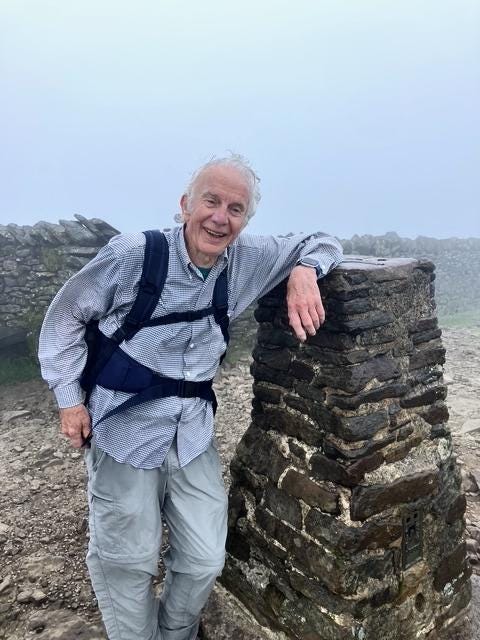
At the top of the hill
83 years old, it is no doubt inevitable that I look back at the years gone by. I look at me today and look around at friends who, like me, inhabit Oldenland, the country of old age. I look ahead to a not so distant horizon.
Oldenland - A Journey in Search of the Good Last Years is the title of my book that was shortlisted in the 2025 Pro-Ageing non-fiction section of the Advantage of Age awards, not quite making it to the winning post. I shall have to wait for a walk on the red carpet.
After days of cloud and rain, of muddy footpaths, and of finding ways to clean boots in our first floor apartment, yesterday changed to a glorious, sunny day, a herald of spring: primroses on the bank that have been displaying themselves since late November, daffodils daring to break into flower, cascades of white blossom on the blackthorn. In the afternoon I don a fleece to ward off the cold breeze and sit reading and musing on the balcony. Lurking in the background is the question as to what life in Oldenland has to offer.
We Oldenlanders are beset with advice as to how best to navigate the terrain - move around, count your steps, watch your diet, tackle something new like learning a language, crosswords and sudoku to exercise the brain, go out, sit on a bench and talk to people, get plenty of sleep, check problems with the doctor. I read about superfoods - nuts, prunes, sprouts, seeds. I am still reasonably fit, walking a lot, but a son suggests that I should exercise with weights to maintain muscle, protect bones and help with balance. I toy with the possibility, but do not get around to actually lifting a weight.
How do we view old age in the grand scheme of a life? Is it a running down, a decline, a getting by as we cope with frailties? Is it a melancholy time in a rocking chair as we look back at past happiness?
I have been ageing over a lifetime, not only as I have added one year to another, but for most of my work life involved in studying, lecturing, researching life in old age. In the 1960s social scientists debated whether the secret to successful ageing was to replace work with other pursuits - a focus on activity and purposeful doing - or to disengage, withdrawing from former roles, recognising a new stage of life.
It’s early morning, I wake early and do not enjoy lying abed when I am not asleep. I look at the fields I see out of the window, whiteness shimmering on the grass, dew, maybe frost. The sun just starting to touch the tops of trees on the hill. A day lies ahead. Nothing in the diary. Will I drift, filling in moments, watching too much, not very special TV? There will be all the usual starting the day activities - breakfast, coffee, newspaper, shower, crossword - and then?
Before the publication of Oldenland I was interviewed about the book for The Telegraph. The subsequent article captured much of what I think and understand about life in old age, but I would like to disown the title that referred to me as someone who had ‘discovered the secret of thriving in old age’. Day by day it doesn’t feel like that as I muddle through. I have not created a pattern for days and weeks that is calm, ordered and satisfying.
Yet I sense this period of my life in front of me as a time of opportunity, a word that fits with thinking about Advantages of Age.
A tree in glorious winter display
It is opportunity to look back, to revisit the past, to reflect and to find a way to absorb the living of the past. I pause, make another cup of coffee, and try to find words to capture what I mean. Of course I want to remember the good times, but I want to do that in a way that does not diminish the present. When out driving we see any number of camper vans, and recall the excitements of past adventures in our van, memories of a lovely camp site on the north coast of Spain where we could watch the light on the water as the tide ebbed and flowed. We no longer have a van - too difficult to manage night time manoeuvrings - and in some ways it’s a relief not to have the looking after of the vehicle. But how we miss those days. And as we look at yet another van passing us by, it’s hard to focus on the wonderful memories and not the disappointment that we shall no longer be having those holidays.
As I look back, I want also to find a way to accept my living, that includes the reality of the mistakes I have made, the hurt to others. An opportunity, if not to resolve maybe to find a way to live with and integrate the disparate parts of a life.
Old age for me is opportunity to be in closer touch with the world around me. People write about a sense of ‘becoming’ in old age, being less self-absorbed; me, soaking up the wonder of the shapes of trees, bare of leaves in the winter months.
In Oldenland I write about a visit to the Barbara Hepworth museum at Wakefield, where I read about the way that she produced sculptures not from moulding metal into a cast, but from carving rocks and wood: carving that takes account of knots and flaws, carving that incorporates cracks and fissures into a finished work of art. I know that we too can carve out our ageing from the reality of our bodies and our lives. We can determine what we want, not conform to the moulds of others.
I put aside the either/or debate of activity or disengagement, realising that I want some of this, some of that. The phrase that I use to describe this is competing imperatives - recognising the validity of aspects that might seem at variance with one another. One such competing imperative is to accept the limitations of my ageing body but yet to challenge the attitude that sees older people as diminished beings.
Another is to want to make decisions for myself, to stay independent, but yet to learn the importance, and indeed the comfort, of accepting help from others.
In front of me is the walk of the rest of my life. A phrase that captures this stage of life is ‘coming home’. Not sure what I mean by this, nevertheless there is an idea of completing my life. I am moving towards my ending - and want to be ready to let go.
In the book I have a number of waymarks, the messages I give to myself. The penultimate waymark is Living in the Twilight.
The day is ending, there is stillness before the dark. ‘Not much happening’, we may think, ‘not much for us to do’. Yet, freeing ourselves from a picture of Oldenland as no more than filling in time, a poor imitation of life as it was, we have an opportunity to look anew: to bring to light what is most important to us in the days we have left, to find a harmony with the world in which we live. We can treasure these quiet moments. We can live, and find what we have become.
A walk in the woods above where we live. I reach the end and circle back to come home, passing a small lake that in days gone by would have fed water to the nearby mill. There is an old bench, covered with leaves. I scrape them away and uncover a carving in the wood bearing a message, so it seems, for me: ENJOY TODAY.
Enjoy today - words carved on a bench in the woods


glorious 💙
I am only 64 and yet find myself too often thinking, Am I aging well? I become hyper- focused on doing all the best things for health. This in itself causes me to miss life. It's like the competing imperatives you note.